
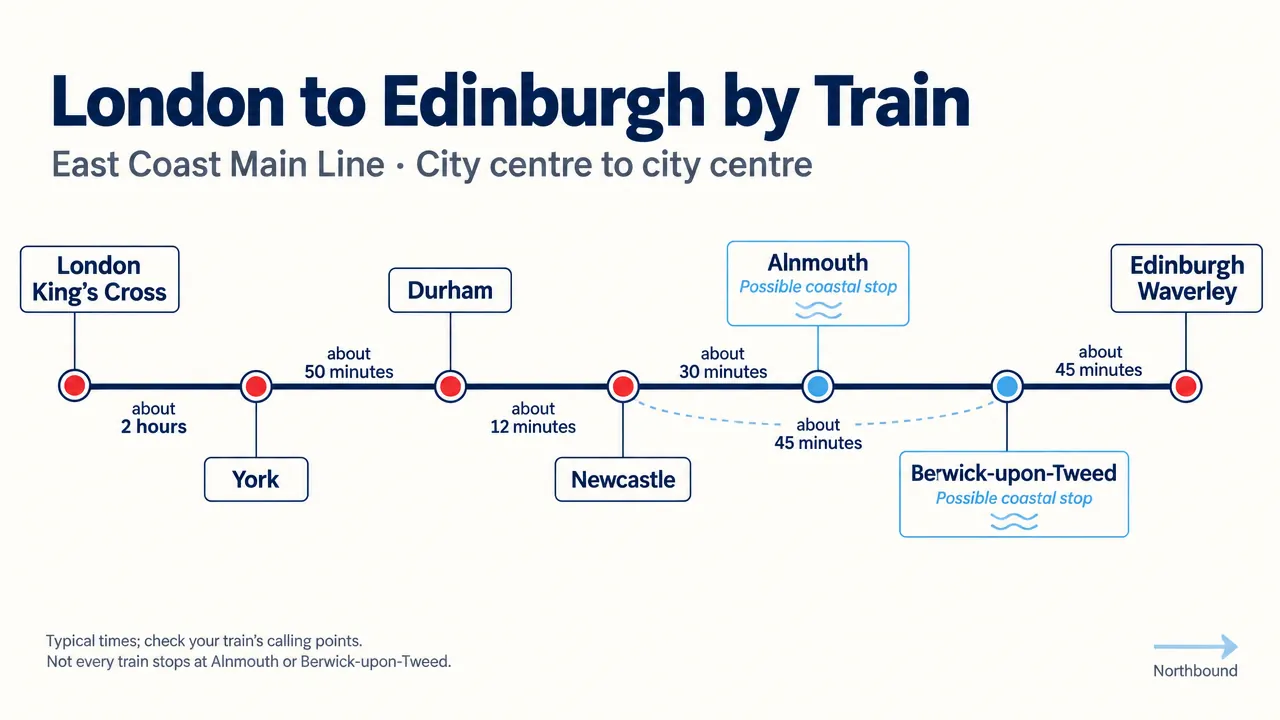
A train journey from London to Edinburgh need not be a single uninterrupted trip. The East Coast Main Line runs through York, Durham and Newcastle before heading towards the Northumberland coast. You could spend a few hours near a station, stay overnight in a city, or allow several days for the castles, villages and beaches farther north.
Plan any stop before booking. The cheapest tickets are tied to a particular train and do not let you leave it for a visit before continuing later. This guide follows the northbound route, setting out typical train times, sights near the stations and ways to divide the journey. Ticket types, seats and luggage arrangements are covered after the stops.
The route at a glance
| Stop | Station | Train time from the preceding stop | Time to allow |
|---|---|---|---|
| London | London King’s Cross | Starting point | — |
| York | York | About 2 hours | 1 or 2 nights |
| Durham | Durham | About 50 minutes | A day or 1 night |
| Newcastle | Newcastle | About 12 minutes | A day or 1 night |
| Northumberland coast | Alnmouth or Berwick-upon-Tweed | About 30 minutes from Newcastle to Alnmouth; 45 minutes to Berwick | 2 or 3 nights with a car |
| Edinburgh | Edinburgh Waverley | About 45 minutes from Berwick, or 1 hour 30 minutes from Newcastle | At least 2 days |
These times are typical of trains that call at the relevant stations, rather than a timetable for every service. Journey times and calling patterns vary: the fastest through trains reach Edinburgh in a little over four hours, but miss some of the stops in this guide. In particular, check coastal station calls before making plans around Alnmouth or Berwick.
Stops along the line
London King’s Cross
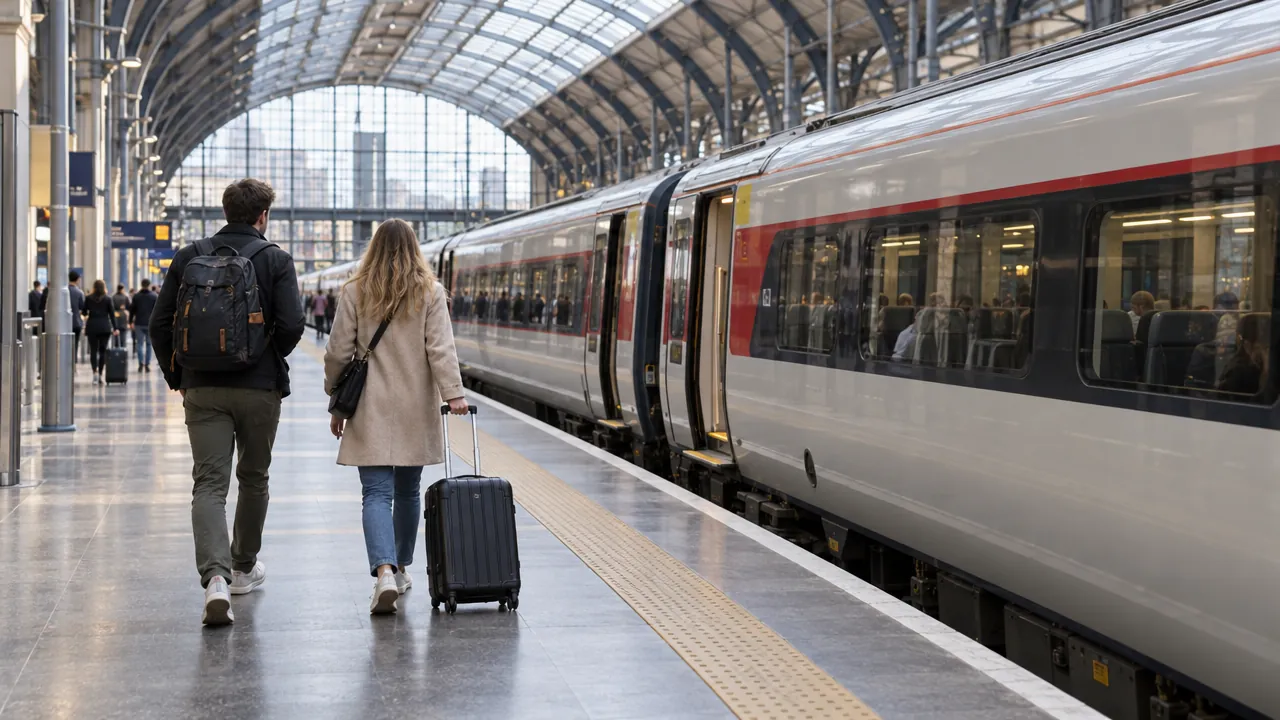
East Coast Main Line trains depart from London King’s Cross, next door to St Pancras International if you arrive by Eurostar. Six Underground lines serve King’s Cross St Pancras below the stations. On the King’s Cross concourse, the main departure board displays the platform before your train leaves. The Platform 9¾ trolley is also on the concourse, so both are easy to locate while waiting to depart.
York

York is about two hours from London and works particularly well if you have room for only one stop. The city walls begin immediately outside the station, and York Minster is roughly a 15-minute walk away. With luggage left near the station, you can walk part of the walls and reach the Minster even if your onward train leaves the same day. One or two nights allow more time, but a day is possible.
- York’s city walls are free to walk. The full circuit takes about two hours; a shorter stretch still provides views across the city. Access is by steps.
- York Minster charges for entry. The Shambles, the city’s well-known medieval street, tends to be quieter early in the day.
- The National Railway Museum is free and stands beside the station. Clifford’s Tower is the keep of York Castle, with a view over the city from the top.
Staying near the station can simplify an overnight break, particularly if you are carrying bags. Abbey Guest House is about a ten-minute walk away; a front room overlooks trains crossing the river. The Bar Convent is another nearby accommodation option and is a working convent. Neither is essential to exploring York: the walls, Minster and other central sights can be reached on foot from the station.
Durham
Durham is around 50 minutes beyond York. Shortly before reaching the station, the train crosses a viaduct above the city: look right for the cathedral and castle on their hill over the River Wear. The cathedral is about a 15-minute walk from the station, with an uphill final stretch. It is the main reason to pause here and, together with the castle, forms a UNESCO World Heritage Site.
- Durham Cathedral offers guided tours most days. Its tower has 325 steps and a view over the city.
- Durham Castle belongs to the university and is visitable only on a guided tour. Tours do not run every day, so it should not be assumed that one will fit a short stop.
- The riverside path loops around the peninsula below the cathedral. The Market Place and older streets descending towards Elvet Bridge offer another walk through the centre.
You could give Durham a full day or stay overnight, depending on how much time you want for the cathedral, castle and riverbanks. Beamish, an open-air museum in County Durham, requires a separate detour rather than fitting into a quick walk from Durham station; the trip described in the source reached it by car.
Newcastle
Newcastle is about 12 minutes north of Durham. The train crosses the River Tyne on the approach to the station, with the city’s other bridges visible to the right. The Quayside is approximately a 10-minute walk from the station. A day or an overnight stay gives you time for the central sights; with a second day, Hadrian’s Wall is an additional outing.
- The Quayside runs beneath the Tyne Bridge. The Millennium Bridge provides a crossing to the Gateshead side of the river.
- Newcastle Castle, a few minutes from the station, is the Norman keep from which the city takes its name.
- Grey Street and Grainger Town contain streets laid out in the 1830s at the city’s centre. Grey’s Monument stands at the top of Grey Street.
- Across the Millennium Bridge, the Baltic is a contemporary art gallery in a former flour mill. Entry is free.
The Angel of the North stands just south of Newcastle in Gateshead, on the site of a former colliery. It is a separate excursion, not another sight on the short station-to-Quayside walk; the source trip visited it by car. If your stop is brief, concentrate on the riverside and central streets rather than trying to include that detour.
The Northumberland coast
North of Newcastle, the railway heads towards the Northumberland coast. From around Alnmouth, the sea comes into view on the right. Alnmouth and Berwick-upon-Tweed are the principal coastal stations for these stops. Alnmouth, about half an hour from Newcastle, serves Alnwick four miles inland. Berwick is about 45 minutes from Newcastle: it is the last station in England, and trains reach it over the Royal Border Bridge.
Not every train calls at both coastal stations, and Lumo calls at neither. Check the calling points for the service you intend to book rather than assuming you can leave any northbound train here. The castles, beaches and villages are spread along the coast; of the places in this guide, this is where a hire car is most useful for linking several locations over two or three nights.
There are alternatives if you do not drive. The X18 or X20 bus takes about 10 minutes from Alnmouth station to Alnwick. Another option is to complete the rail journey to Edinburgh and return to selected Northumberland sights on a small-group day tour. That provides transport between its scheduled stops, but not the freedom to choose the route and timing that a car offers.
- In Alnwick, there is Alnwick Castle and The Alnwick Garden. The castle closes over winter. Barter Books, a large second-hand bookshop, occupies the town’s former railway station.
- Bamburgh Castle stands above a long sandy beach. Seahouses is a place for fish and chips or boats to the Farne Islands.
- Holy Island is cut off by the tide twice a day. Plan any visit around the published safe crossing times.
- Berwick-upon-Tweed’s Elizabethan walls encircle its old town.
Alnwick, Bamburgh, Seahouses and Berwick are all possible bases when travelling with a car. Your choice affects which stretches of coast are convenient to explore, so this part of the journey merits more time than a brief station stop. If you are relying on a tour instead, its itinerary determines which places you will actually see.
One day tour described in the source gave visitors three hours in Alnwick and stopped for a view of Bamburgh Castle from the beach. It left Edinburgh Bus Station at 8.45 am in a 16-seat mini-coach, visited Kelso, Alnwick and Dunbar, and returned at around 6.15 pm. Entry to Alnwick Castle cost extra. Those timings and stops describe that particular tour, not Northumberland tours in general.
Edinburgh
From Berwick, Edinburgh is about 45 minutes by train, with the sea on the right for the first part. From Newcastle, the journey takes around an hour and a half. Edinburgh Waverley lies between the Old Town and New Town, though the walk uphill from the station to the Royal Mile is steep. Allow at least two days if you want to see the main sights rather than simply finish your train journey here.
- Edinburgh Castle overlooks the city. Day tickets often sell out, making advance booking sensible.
- The Royal Mile runs downhill from the castle to Holyrood. Narrow lanes called closes lead off both sides; St Giles’ Cathedral is halfway down. Cathedral entry is free, with a donation suggested.
- Victoria Street and the Grassmarket are below the castle. The Vennel steps lead off the Grassmarket.
- The National Museum of Scotland and the National Gallery are both free to enter.
For accommodation, station access and luggage matter alongside location. Elder York Guest House is a few minutes’ walk from Princes Street, but has no lift and is three flights up, which may be difficult with heavy cases. Virgin Hotels Edinburgh is on Victoria Street in the Old Town, about an eight-minute walk from Waverley. These are location examples rather than necessary stops on an Edinburgh visit.
Three ways to divide the journey
One stop: York
For a simple break in the London–Edinburgh trip, stop in York for one or two nights, then take a train onwards to Edinburgh. That second leg takes about two and a half hours. York also suits a shorter visit: if you leave your bags near the station, you can walk a section of the walls and reach the Minster before returning for your booked train. How much more you see depends on the time between services.
Two stops: York and Durham
If you have time for another break, continue from York to Durham, a train journey of under an hour. A day there can cover the cathedral, castle and riverbanks, while an overnight stay removes the pressure of fitting everything between trains. Check Durham Castle tour availability independently: visits are guided only, and tours do not run every day.
A longer journey through Newcastle and Northumberland
Newcastle and the coast take more time than a brief pause between trains. Around a week on the way to Edinburgh could be divided as below. The coastal portion assumes a hire car to connect places that are spread apart; after that, you could continue to Edinburgh by train or drive. This division leaves the suggested two days or more in Edinburgh for the end of the trip.
- York: 2 nights.
- Durham: 1 night.
- Newcastle: 1 night.
- Northumberland coast: 2 or 3 nights with a hire car.
- Then continue to Edinburgh.
Tickets, seats and luggage
Which trains serve the stops?
LNER operates most trains on this route and serves every stop covered here, although an individual LNER service will not necessarily call at Alnmouth or Berwick. Lumo travels between London and Edinburgh via Newcastle and Morpeth; it does not stop at York or Durham. Lumo has standard class only and reserves a seat for every passenger. Grand Central runs between London and York on its way to Sunderland. CrossCountry and TransPennine Express also run between York, Newcastle and Edinburgh, offering options for shorter legs.
Tickets for planned stops
An Advance ticket is valid only on the train booked and does not allow a break of journey. A single London–Edinburgh Advance ticket therefore cannot be used to get off in York for a visit and continue later. Advance tickets are the cheapest type described here, with long-leg fares generally lowest when booked well ahead. By contrast, the short Durham-to-Newcastle hop can be bought on the day.
LNER’s 70min Flex ticket applies between London and Newcastle, Berwick or Edinburgh, routes on which LNER no longer sells Off-Peak tickets. It lets you take your booked train or another LNER service up to 70 minutes before or after it. That window is too short for the visits described here. An Anytime ticket allows a break of journey, but is the most expensive of these ticket types.
For a planned multi-stop trip, the straightforward approach is to book each leg separately: London to York, York to Durham, and so on. Add up the fares before committing, because several tickets can cost more than a single through fare depending on your dates. The important distinction is between arranging the stops as separate journeys and assuming a ticket for one train will permit an unplanned break.
Railcards and passes
Overseas visitors can buy a railcard. The Senior Railcard is for people aged 60 or over; it and the Two Together Railcard take a third off most fares, subject to some time restrictions. Both can be purchased online as digital cards. Whether either helps on this itinerary depends on the tickets you need and the journeys you will make.
A BritRail Pass offers another way to make the stops. LNER and Lumo accept it, and it lets you get on and off along the route without buying a separate ticket for every leg. Lumo asks pass holders to reserve a seat. Compare the pass with separate tickets rather than assuming it is cheaper: the answer depends partly on how many other train journeys are in your plans.
Seats and views
Heading north, the right-hand side is the one for the views noted along this route: Durham Cathedral from the viaduct, the Tyne bridges as you reach Newcastle, and the sea from around Alnmouth onwards. LNER lets passengers choose a seat when booking directly. The Lumo booking described in the source did not allow a choice of side, so it could not ensure a right-hand window seat.
Bags and short stopovers
LNER asks passengers to carry their own bags. Small and medium cases fit overhead or under a seat; large suitcases go in racks at the ends of the coach. Lumo sets a luggage allowance for each passenger, particularly relevant if you have large cases. For stops of only a few hours, luggage-storage services offer drop-off points in shops and hotels near York, Durham and Newcastle stations. Factor storage into your plans if you do not want to carry a case while walking around the sights.